be suffering some setbacks. The Kupuna Caregivers Program initially paid up
to $70 a day for five days a week for some services. Now, it may be cutting
that back to just one day a week. This article originally appeared in KITV on June 21, 2018.
Better Life Lab | Slate
By Diane Ako
HONOLULU –
A state program meant to give full time caregivers some financial help may be suffering some setbacks. The Kupuna Caregivers Program initially paid up to $70 a day for five days a week for some services. Now, it may be cutting that back to just one day a week.
Waipio Gentry resident Dwight Inokuma takes care of his mother Jane, who has dementia. Five days a week, he brings her to and from Hale Hauoli Hawaii adult day care. “I love my mom very much. That’s why I keep her at home. I just want to keep her happy,” he says.
After almost two years of care, Jane’s savings ran out. Dwight now pays for her. “I don’t mind using my retirement account to keep her at home because she’s happier over there,” says Dwight.
That’s why Inokuma is thrilled about the state’s Kupuna Care Act. Through it, the state pays for Jane’s day care.
AARP Hawaii’s Communications Director Craig Gima explains, “The Kupuna Care Act is aimed at working caregivers to keep them in the workplace. It sets up a modest program to help people with services like senior respite, senior day care, meals, transportation.”?
A last-minute, little-known proviso in House Bill 1900 cuts back funding by 80%. It reads:
“SECTION 16.1 Provided that of the general fund appropriation for executive office on aging (HTH904), the sum of $1,200,000 or so much thereof as may be necessary for fiscal year 2018-2019 shall be expended for the kupuna caregivers program; provided further that the executive office on aging shall limit the benefits for each qualified recipient to once per week.”
Gima says, “That would basically limit services to once a week. That creates a problem. People’s needs are different.”
The fiscal year starts July 1, 2018. We asked the Governor’s office how it would respond to the proviso. We were told exactly this: “The Kupuna Caregiver program was created by the legislature in the Hawaii Revised Statutes. The Hawaii State Constitution requires that amendments to HRS must be made through a bill that embraces that specific topic — the budget bill relates to general appropriations and cannot be used to change specific statutes.
Section 14. No law shall be passed except by bill. Each law shall embrace but one subject, which shall be expressed in its title. The enacting clause of each law shall be, “Be it enacted by the legislature of the State of Hawaii.” [Ren Const Con 1978 and election Nov 7, 1978]”
Caring Across Generations, a national coalition of caregivers, wrote to the Governor’s office saying, “The restrictive nature of the proviso, despite its good intention, would fundamentally disrupt the goal of the program. Providing a $70 benefit once a week is simply not substantial enough to allow working family caregivers to remain in the workforce and provide care for an aging parent.”
Inokuma says day care is expensive. “Maybe a thousand something a month,” he guesstimates.
He’s already tightened up his budget. “I kind of cut a lot of things like my cell phone,” he says, meaning, he switched to a cheaper plan.
Even if Kupuna Caregivers Program pays for less this fiscal year, caregivers and elder advocates are still grateful. “It’s only $70 a week, but that still helps out,” says Inokuma.
Gima agrees. “We’re the first state in the country to try this. The Legislature needs to be applauded for doing this.”
]]>Aging Well: Kupuna Caregivers Program may cut back funding for fiscal year 2018Popular subsidies for kupuna caregivers set to be greatly restrictedMatthew CainMon, 16 Jul 2018 13:43:01 +0000http://www.care4kupuna.com/news/2018/7/13/popular-subsidies-for-kupuna-caregivers-set-to-be-greatly-restricted566f4f0c1115e08104bc8f3b:56a1563afd5d084fb716dab7:5b48c8246d2a7363e8464a8fA major change to a financial assistance program designed to help those
caring for Hawaii’s senior citizens is upsetting some caregivers.This article originally appeared in Hawaii News Now on April 30, 2018
News | Hawaii Now News
By Lisa Kubota, Anchor / Reporter
HONOLULU (HawaiiNewsNow) –
A major change to a financial assistance program designed to help those caring for Hawaii’s senior citizens is upsetting some caregivers.
Under the current program, people who work at least 30 hours a week while taking care of a senior may be eligible to receive subsidies of up to $70 a day five days a week for services such as adult day care. But lawmakers now want to limit the value of subsidies issued for each participant to just $70 per week. The funds are paid directly to contracted service providers.
Critics of the change to the Kupuna Caregivers Program say it will greatly undermine its utility, which was aimed at helping caregivers remain in the workforce and heralded as a model for the nation.
But legislators say the pilot program was never meant to be a daily subsidy, just a way to give caregivers a little respite each week.
The change comes as lawmakers are also doubling funding for the program in the upcoming year to $1.2 million.
State Rep. Sylvia Luke, chairwoman of the House Finance Committee, said the additional funding and the new limits on the program will mean that ten times as many people will be able to get help.
Luke said in the first year of the program, some $600,000 in funds covered day care funding for about 90 recipients.
“We’re a little troubled” by those figures, Luke said. “To serve only 90 people, that’s not the best approach.”
But others say the change will mean caregivers who work won’t get the help they need.
“To drop it down to only paying for one day, that’s not going to help the caregivers stay in the workforce,” said Kathy Wyatt, president of Hale Hauoli Hawaii, which provides adult day care services. “That just defeats the whole purpose of the program.”
Iris Yafuso-Toguchi sends her elderly mother, who suffers from Alzheimer’s disease, to Hale Hauoli Hawaii five days a week. The Aiea family recently qualified for the program, but Yafuso-Toguchi was disappointed to hear about the change.
“Knowing that it’s only one day, I’m not trying to sound greedy, but I’m just like ‘oh, shoot.’ I think it’s heart-wrenching. It’s sad that it had to be that way,” she said.
The funding for the program is in the state budget, which still needs to be approved by the governor.
“We want the Executive Office on Aging to look at other things like Kupuna Care planning, home chore services, a whole range of meal services or transportation services,” said state Rep. Della Au Belatti (D-Makiki, McCully).
Copyright 2018 Hawaii News Now. All rights reserved.
]]>Popular subsidies for kupuna caregivers set to be greatly restrictedMaui Sen. Roz Baker Named Capitol CaregiverMatthew CainMon, 16 Jul 2018 13:40:10 +0000http://www.care4kupuna.com/news/2018/7/13/maui-sen-roz-baker-named-capitol-caregiver566f4f0c1115e08104bc8f3b:56a1563afd5d084fb716dab7:5b48c4ae352f538610b01354In recognition of her integral work to support family caregivers in
Hawai‘i, AARP named Maui Sen. Roz Baker as a 2017 “Capitol Caregiver.”This article originally appeared in Maui Now on March 29, 2018
Maui Business | Maui Now
By Maui Staff
In recognition of her integral work to support family caregivers in Hawai‘i, AARP named Maui Sen. Roz Baker as a 2017 “Capitol Caregiver.”
Sen. Baker joins a bipartisan group of nearly 100 elected officials from more than 30 states cited by AARP for their work to support family caregivers, who help their parents, spouses and other loved ones live independently at home and in the community—where they want to be.
“AARP thanks Sen. Roz Baker for championing the Kupuna Caregiver bill, SB 534/HB 607 in 2017,” said Barbara Kim Stanton, Hawai‘i state director of AARP, which serves nearly 150,000 members age 50 and older in Hawai‘i. “She deservedly received national recognition for sponsoring the legislation to create the first-of-its-kind-in-the-nation program to help working caregivers. The new program helps make the big responsibilities of family caregivers in Hawai‘i a little bit easier.”
The Kupuna Caregivers program, which started earlier this year, provides up to $70 a day of services, such as senior day care, so that working caregivers can continue to work while providing family caregiving to a loved one. Officials say funding of up to $4-million is working its way through the Legislature this year to expand the program to help more people.
“Family caregivers provide invaluable care to their loved ones,” said Baker. “As Hawai‘i’s population ages, it’s important that the Legislature supports kupuna and the family caregivers who take care of them.”
Across Hawai‘i, about 154,000 family caregivers provide unpaid care for their older parents, spouses, children and adults with disabilities, and other loved ones— valued at about $2.1 billion annually. They help with bathing and dressing, meal preparation, managing finances, transportation, grocery shopping and more.
AARP National President Eric Schneidewind presented the award to Baker in her office during a visit to Hawai‘i last week.
“The Kupuna Caregiver program is an important step to providing a little bit of help for family caregivers,” Schneidewind said. “With this program, Hawai‘i is taking a leadership role in supporting working caregivers.”
]]>Maui Sen. Roz Baker Named Capitol CaregiverLawmakers look to expand innovative program that offers financial help to caregiversMatthew CainMon, 16 Jul 2018 13:39:27 +0000http://www.care4kupuna.com/news/2018/7/13/lawmakers-look-to-expand-innovative-program-that-offers-financial-help-to-caregivers566f4f0c1115e08104bc8f3b:56a1563afd5d084fb716dab7:5b48c32f0e2e72fb07ace7d5Interest in a new pilot project that offers financial support to Hawaii’s
working caregivers is extremely high, and now a couple of proposals to
provide additional funding are advancing at the state Capitol.This article originally appeared in Hawaii News Now on February 13, 2018.
News | Hawaii News Now
By Lisa Kubota, Anchor / Reporter
Interest in a new pilot project that offers financial support to Hawaii’s working caregivers is extremely high, and now a couple of proposals to provide additional funding are advancing at the state Capitol.
A House committee on Tuesday approved a measure that would provide $2 million for the Kupuna Caregivers Program which is designed to help keep people in the workforce. A Senate companion bill asks for $4 million.
“There are over 154,000 caregivers in the state and about 50 percent of them are working a full-time job and also taking care of somebody at home. This is important because it helps those people stay employed,” said Pedro Haro, Hawaii advocacy director for Caring Across Generations.
Cynthia Goto shared her experience with lawmakers. She is a caregiver for her 86-year-old mother and 96-year-old grandfather. Both of them have Alzheimer’s disease.
“I am grateful to be able to help take care of them because they took care of us as we were growing up,” she said. “So my sister and I do the best we can.”
The current funding of $600,000 is expected to cover 50 to 135 people statewide, but there have been more than 1,500 inquiries since the program’s launch two months ago.
People who are employed while also caring for kupuna may be eligible for services such as adult day care and meal delivery that are valued at up to $70 per day.
The funds are paid directly to contracted service providers. Participants are chosen based on need.
“We’re going through each one, assessing each individual person’s needs to find out how we can best help the caregiver,” said Caroline Cadirao, grants manager in the state’s Executive Office on Aging.
Two people on Maui have already been enrolled and seven others on Kauai and Maui have been authorized for services.
To be eligible, caregivers must be employed at least 30 hours a week and provide direct care to a senior citizen who is a U.S. citizen or a qualified alien.
The care recipient must be at least 60 years old and not be covered by any comparable government or community-based care service, except Kupuna Care services.
The recipient cannot live in a long-term care facility.
Copyright 2018 Hawaii News Now. All rights reserved.
]]>Lawmakers look to expand innovative program that offers financial help to caregiversKupuna Caregivers Program a Shining ExampleMatthew CainMon, 16 Jul 2018 13:38:29 +0000http://www.care4kupuna.com/news/2018/7/13/kupuna-caregivers-program-a-shining-example566f4f0c1115e08104bc8f3b:56a1563afd5d084fb716dab7:5b48c152575d1fcdb9e958baWhile political discourse tends to be in the news on a daily basis on the
national stage, we can often take for granted that, even in difficult
legislative sessions, our local elected officials are able to work together
to prioritize shared community needs.This article originally appeared in Civil Beat on January 3, 2018.
Community Voice | Civil Beat
By Pedro Haro
While political discourse tends to be in the news on a daily basis on the national stage, we can often take for granted that, even in difficult legislative sessions, our local elected officials are able to work together to prioritize shared community needs.
The Kupuna Caregivers Act, passed by the 2017 Legislature and enacted into law by Gov. David Ige, is a true example of how both our state leaders and the people of Hawaii scored a huge win by creating social infrastructure for our future.
In order to help family caregivers, who face the constant challenge of balancing their paying jobs with the work of caring for aging loved ones, the Kupuna Caregivers program provides up to $70 a day in services aimed at easing the burdens that come with being a working caregiver.
This model seeks to aid, not replace, the cadre of family caregivers who provide millions of hours of unpaid care each year to older adults in Hawaii.
This first-in-the-nation program has captured the attention of national experts and media, with the New York Times, MSNBC and the Washington Examiner running lengthy pieces on the new initiative.
Local audiences have also responded positively: The Executive Office on Aging, the state agency tasked with enacting the program, has received hundreds of calls from Hawaii’s families wanting to receive the benefit.
The national praise for the program tends to focus on the innovative approach to supporting family caregivers and kupuna, but it is also worth celebrating the strategic coordination from Hawaii’s legislative leaders as a case study in making progressive change.
No Opposition
Introduced by kupuna and health advocates Sen. Roz Baker and Rep. Greg Takayama in their respective chambers, Human Services committee chairs Sen. Josh Green and Rep. Dee Morikawa quickly moved the measure through their committees while sharpening the language and ensuring clear intent of the program.
The legislation even mustered support from the budget guard team of former Senate Ways and Mean Chair Jill Tokuda and House Finance Chair Sylvia Luke. Once all was said and done, the bill had not received a single “no” vote in committee or full House and Senate votes.
The governor proudly signed the bill into law and, just as importantly, quickly released the funds to start to launch the program.
It’s true that the bill funding was not the amount for which advocates had originally asked. Of the $6.6 million dollars requested, only $600,000 was appropriated, which was originally intended for administrative costs.
Proving that government can in fact run lean and efficiently, the Executive Office on Aging invested all those funds into service delivery rather than administrative costs, releasing the program in what must be the fastest launch of a new program in the state and beginning enrollment before 2018.
In a year where the Honolulu rail project seemed destined to demand any available tax dollars, and the crisis regarding Hawaii’s response to homelessness dominated the media cycle, it was a particular accomplishment to establish a new piece of long-term care infrastructure.
To ensure the program helps caregiving families and realizes its potential as a long-term cost-saving program for the state, the Kupuna Caregivers program must be seen as the initial investment, not an end, to creating long-term care infrastructure in Hawaii.
In 2018, legislators will have the opportunity to properly fund the rest of the $6 million required to help hundreds of families across the state. Just as in 2017, the Kupuna Caregivers program is an opportunity to cast a vision of what lawmakers and government in Hawaii can do for the residents of the state
]]>Kupuna Caregivers Program a Shining ExampleFive Good Things That Happened to American Workplaces in 2017Matthew CainThu, 12 Jul 2018 13:50:24 +0000http://www.care4kupuna.com/news/2018/7/12/five-good-things-that-happened-to-american-workplaces-in-2017566f4f0c1115e08104bc8f3b:56a1563afd5d084fb716dab7:5b4759756d2a733141a186a5Slate identifies Kupuna Caregivers as a highlight for working families in
2017. “For American workers increasingly sandwiched between their careers
and the need to provide care to kids and their aging parents, Kapuna
represents a badly needed path forward.”This article originally appeared in Slate on December 29, 2017.
Better Life Lab | Slate
By Slate Staff
The past year brought us many reasons to worry about our chances of achieving that happy work-life balance we dream about—given the seemingly endless number of regulations and worker protections the Trump administration has cut, the major changes to the National Labor Relations Board, and now many questions about what the largest piece of tax reform legislation in history will do to our economy. Still, it’s worth remembering that even a tough year has a silver lining, and there is hope that our best work-lives are still ahead of us. From a national movement to snuff out toxic work cultures to state and local innovations for balancing work and family, 2017 offered some good with the bad.
Here, members of the Better Life Lab team at New America highlight five seriously good things that happened for American workplaces in 2017:
1. #MeToo
In September, the courageous voices of a few women set off a tsunami of disclosures of widespread workplace sexual harassment across sectors as varied as movie-making, news media, politics, and academia. Amplified by social media and the #MeToo hashtag that allowed women from all walks of life to share their experiences with harassment and make the case for its pervasiveness, the groundswell removed prominent men from their positions of power. More importantly, #MeToo and the surrounding disclosures, while horrifying, spurred a broader conversation about behavior in the workplace and sex and gender and power dynamics. Men and women are re-examining their workplace interactions and employers are thinking anew about how they create structures and processes to allow for victims to tell their stories and end these all-too-common abuses. —Amanda Lenhart
2. Schedule stability in Oregon
In August, Oregon became the first state in the country to pass a law ensuring schedule predictability and stability to the hourly workers of large employers. The law, which goes into effect in July, requires employers with more than 500 workers to give their employees advance notice of schedules (one week in 2018, two weeks in 2020), adequate rest (10 hours) between shifts, and the right to request certain shifts or workplaces—or pay a “predictability” premium. The law, which passed with solid bipartisan support, is designed to both put an end to the erratic and unpredictable schedules that wreak havoc on the lives, health, and livelihoods of hourly workers and to help businesses by creating a healthier environment for workers that will reduce costly absenteeism and turnover.
In recent years, increasingly erratic schedules have become the norm for the hourly workforce through a combination of new scheduling software and the pressure to cut labor costs. With behemoths like Walmart, McDonald’s, Home Depot, and Kroger, the retail and fast food sectors are by far the largest civilian employment areas in the United States. Pressure from online competitors like Amazon has forced what some call a retail jobs “apocalypse,” with, for instance, more department store jobs lost in the past 15 years than coal mining or factory jobs. The Oregon predictable scheduling law follows city ordinances in Seattle, San Francisco, and New York and is seen a model for legislation that lawmakers from both parties can support. —Brigid Schulte
3. Hawaii’s solution to the elder care crisis
In July, Hawaii passed the Kupuna Caregiver Assistance Act, ensuring that senior citizens in the state and their working family members have access to the elder care they need. The act grants primary caregivers who work at least 30 hours a week with up to $70 a day in assistance from professional home aides. Hawaii rose to face the challenges presented by an aging population and an extremely high cost of living, a challenge that the rest of the United States faces or will soon face. Working family members who also perform unpaid elder care, a role primarily held by women, can now remain in the workforce. The benefits of the Kupuna Caregiver Assistance Act extend beyond the family and into local businesses as employers can now retain valuable skilled workers.
The passing of this landmark legislation carries implications for the future of elder care in the United States. Hawaii’s program serves as a potential inspiration and a data source for how other states could enact similar legislation. For American workers increasingly sandwiched between their careers and the need to provide care to kids and their aging parents, Kapuna represents a badly needed path forward. —Roselyn Miller
4. Paid parental leave in San Francisco
Life got a lot easier for many working parents in San Francisco this year. That’s because the city passed a new paid parental leave law and became the first city in the country to offer six weeks of fully paid parental leave. It officially went into effect in January. Even before that, California was already a good place (compared with other states) to have a kid: It pays 55 percent of a worker’s salary for up to six weeks. This new city law requires that employers pay the 45 percent difference, and it was expected to raise the average weekly salary from $743 to $1,351. It could make an especially big difference for low-income populations that don’t work for big tech giants and don’t have access to generous leave policies.
Unsurprisingly, the business community’s reaction to the new law has been mixed, and some economic analysis has suggested it could slow hiring and job creation. But right now, it’s impossible to predict the ultimate outcome and impact on families and on business at large. And it’s impossible to know whether it could or should be a model for other cities. But it is possible to applaud San Francisco’s spirit of experimentation—of trying something rather than nothing and for giving the rest of the country a starting point for action. —Elizabeth Weingarten
5. The rise of remote work
As one of only two countries in the world offering zero weeks of guaranteed paid leave to workers for family or health crises (alongside Papua New Guinea), the U.S. workforce is desperate for more jobs that don’t require onsite, regularly set shifts. And 2017 seems to have made even more managers and workers converts to the glories of flexible working than ever before. According to a 2017 report from FlexJobs, a service that helps companies recruit flexible workers, remote working has increased by 115 percent in the past decade. With the uptake of new technologies like Zoom, for all your video conferencing needs; Slack, for regular interoffice chatting and info-sharing; and seemingly endless options for finding pop-in co-working spaces in your own neighborhood, the reasons for employers not to accommodate teleworking are fewer than ever.
To help meet these needs, a new job board, Werk, exclusively connects job-seekers with companies that want to attract remote and flexible workers. The demand for setups that allow Americans to both live and work at the same time is here. Here’s to hoping 2018 is the year more workplaces step up to meet it. —Haley Swenson
Better Life Lab is a partnership of Slate and New America.
]]>Five Good Things That Happened to American Workplaces in 2017One of the smartest ideas for balancing work and life just went into effect in HawaiiMatthew CainTue, 19 Dec 2017 17:01:00 +0000http://www.care4kupuna.com/news/2018/2/2/one-of-the-smartest-ideas-for-balancing-work-and-life-just-went-into-effect-in-hawaii566f4f0c1115e08104bc8f3b:56a1563afd5d084fb716dab7:5a7498bcf9619a695418992dThe term “kupuna” in Hawaiian translates roughly to elder, or grandparent,
or simply an older person held in high esteem. A new state program puts
money behind Hawaii’s commitment to its older generations, and to the
family members caring for loved ones in their later years.Golden Years | Quartz
By Corinne Purtill
This article originally appeared on Quartz on December 19, 2017. Read it there.
The term “kupuna” in Hawaiian translates roughly to elder, or grandparent, or simply an older person held in high esteem. A new state program puts money behind Hawaii’s commitment to its older generations, and to the family members caring for loved ones in their later years.
In July, Hawaii governor David Ige signed into law the Kupuna Caregivers Assistance Act. The bill, which took effect earlier this month, provides a stipend of up to $70 per day for people who work at least 30 hours per week while also caring for an elderly family member. The money can be used for anything that helps the caregiver meet his or her responsibilities without having to sacrifice work, such as a part-time home aide, meal deliveries, or cleaning services. It can also be used to supplement wages the caregiver loses while providing these services. The money comes from existing revenues in the state’s general fund, which is funded primarily by income and corporate taxes.
The goal is to help caregivers stay in the workforce for as long as they want to, while still helping their loved one live as healthy and independent a life as possible.
Hawaii, the US state with the longest life expectancy, is the first in the US to implement this type of direct subsidy for long-term care. Germany, Austria, Japan, and a handful of other industrialized nations have developed universal insurance programs for their elderly’s long-term care. Yet many countries (the US included) have not prepared for the demographic reality that the number of elderly people in need of care is growing rapidly—and with the rise of dual-income households, fewer younger family members are home full-time and able to consistently provide that care themselves.
While the challenges facing working parents are finally received much-deserved policy attention, so do the needs of the estimated 44 million Americans taking care of an elderly family member. More than 60% of those caregivers—approximately 26.4 million people—are also employed, a dual responsibility that can take a toll on an employee’s job performance.
That lost time at work comes at a significant cost, both to the employee and the economy. The cost of leaving the workforce early to care for an aging relative comes to about $304,000 in lost wages and benefits for the former employee, according to a 2012 study from AARP. The same study found that US businesses lose an estimated $33.6 billion each year in productivity from workers tending to caregiving responsibilities.
A $70 daily stipend can’t cover all of an elderly person’s needs. Yet for overtaxed workers giving their all at work and at home, Hawaii’s Kupuna program offers much-needed help—and an intriguing example for the rest of the country to follow.
]]>One of the smartest ideas for balancing work and life just went into effect in HawaiiEasing the Burden on CaregiversMatthew CainFri, 15 Dec 2017 16:42:00 +0000http://www.care4kupuna.com/news/2018/2/2/easing-the-burden-on-caregivers566f4f0c1115e08104bc8f3b:56a1563afd5d084fb716dab7:5a749240f9619a6954168ba9Eleanor Thommes and her sister have reorganized their schedules and
finances to take care of their 93-year-old mother, Elising Roxas, who needs
round-the-clock care.
“A lot of women, especially single women, need to work,” said Ms. Thommes,
63, who lives in Mililani, Hawaii. “But at the same time they have all
these responsibilities, to pay the bills, and to caregive. How can they
possibly do all of that the same time?”Well | The New York Times
By Maureen Towey
This article originally appeared in the New York Times on December 15, 2017. Read it there.
Eleanor Thommes and her sister have reorganized their schedules and finances to take care of their 93-year-old mother, Elising Roxas, who needs round-the-clock care.
“A lot of women, especially single women, need to work,” said Ms. Thommes, 63, who lives in Mililani, Hawaii. “But at the same time they have all these responsibilities, to pay the bills, and to caregive. How can they possibly do all of that the same time?”
A new program in Hawaii, the Kupuna Caregivers Act, is designed to help lift some of the burden on people caring for an elderly family member at home by paying them stipends of up to $70 a day. The word Kupuna means elder in Hawaiian.
The program, which went into effect this week, is limited to those who work at least 30 hours per week. The money can be used for caregiving supplies, to supplement lost wages or to hire help. The legislation recognizes that many Hawaiian families prefer to have their parents and grandparents age at home, rather than in a nursing home or assisted living facility.
Long-term care continues to be a complicated equation for many Americans. Private long-term care insurance is a shrinking industry with premiums too expensive for many people to afford. For low-income families, Medicaid offers some options. At the state level, Maine and Washington are also considering their own programs.
Washington has been a leader in long-term care for many years. In 2017, it was ranked first in the quality and execution of long-term care in a study commissioned by AARP and several partner organizations. Representative Laurie Jinkins, a Democrat, and Representative Norm Johnson, a Republican, introduced a bill last winter called the Long-Term Care Trust Act, which would provide universal long-term care in the state. Everyone would contribute through a payroll deduction, and everyone would be guaranteed a long-term benefit if needed. The program would provide $100 a day to support caregiving across a range of care situations including at-home care, assisted living and nursing homes. Washingtonians have a strong track record of passing legislation on a similar model, including universal paid family leave in 2017 and universal paid sick leave in 2016. The bill is expected to be reintroduced in early 2018.
In Maine, 59 percent of the population identifies as current or former caregivers. The Maine People’s Alliance is collecting signatures for a ballot initiative calling for universal home care, which would make home caregiving available to people over 65 or those with disabilities. The proposed budget for this program would be funded by a 1.9 percent Social Security tax on people making over $127,000.
“We’ve gotten a more emotional reaction to this campaign than anything else we’ve worked on,” said Ben Chin, the political engagement director of the Maine People’s Alliance.
Health care legislation in Maine has been hotly debated recently as Gov. Paul LePage, a Republican, has vetoed Medicaid expansions five times, though a recent ballot measure did push through that expansion. The Maine’s People’s Alliance anticipates reaching its signature goal by the end of January.
The proposed legislation in Washington is limited to 365 days (consecutive or not) of caregiving support and the Kupuna Caregivers program is starting with a six-month trial period. With those limits, these programs aren’t meant to be lifetime care. But they offer options for families that can’t afford private insurance and don’t want to spend down retirement savings to qualify for Medicaid.
The programs could provide relief for struggling families and serve as models for other states.
]]>Easing the Burden on CaregiversElder Care Is a Looming Crisis. Hawaii Is Facing It Head-On.Matthew CainMon, 05 Jun 2017 15:57:00 +0000http://www.care4kupuna.com/news/2018/2/2/elder-care-is-a-looming-crisis-hawaii-is-facing-it-head-on566f4f0c1115e08104bc8f3b:56a1563afd5d084fb716dab7:5a7496fa8165f558e19f6819In Hawaii, senior citizens are kupuna. The Hawaiian word, used in roughly
the same way as elder or grandparent, denotes reverence for experience and
wisdom. Throughout history, Hawaiian culture has placed a high value on
children and grandchildren caring for their kupuna, helping them age with
dignity in their own homes and communities.Better Life Lab | Slate
By Christina Cauterucci
This article originally appeared on Slate on June 5, 2017.
In Hawaii, senior citizens are kupuna. The Hawaiian word, used in roughly the same way as elder or grandparent, denotes reverence for experience and wisdom. Throughout history, Hawaiian culture has placed a high value on children and grandchildren caring for their kupuna, helping them age with dignity in their own homes and communities.
So when organizers from Caring Across Generations, a national caregiving advocacy group, began talking to Hawaii residents in 2015 about legislation that would guarantee universal long-term care for seniors, they were surprised to get pushback. “I thought, OK, this is going to have near universal support when you start to talk to people,” says Caring Across Generations’ political director, Kevin Simowitz. “And I was surprised at how often, early in the conversation, people would say some version of, ‘I don’t think this is somebody else’s responsibility. I think care is my responsibility. My parents are getting older—I should take care of them.’”
The bill sputtered out on the governor’s desk. But a new elder-care bill that recently passed both chambers of the Hawaii legislature looks poised to make it all the way into law. Advocates say the program it establishes will help people live up to the responsibility Hawaiians feel for their kupuna, rather than trying to replace the strong existing tradition of elder care.
If Gov. David Ige signs this legislation, people who work at least 30 hours a week outside the home and serve their kupuna as primary caregivers will be eligible for up to $70 a day in help from trained home aides. The Kupuna Caregiver Assistance Program would help a family caregiver continue to work outside the home, get some necessary breaks in caregiving work, and give her the money to pay a fair wage to the care workers she hires. It’s an important step toward meeting the needs of a fast-aging population and the family members who are expected—but too often financially unequipped—to shoulder the burden.
States around the country are preparing for a crisis in elder care as baby boomers age and develop debilitating age-related conditions. According to U.S. Census projections, by 2030, more than one-fifth of the U.S. population will be 65 years of age or older, up from 13 percent in 2010. But Hawaii is facing an even more urgent demographic shift. At 82, the Hawaii life expectancy is longer than any other state’s, and some analysts predict that 30 percent of the population could be 65 and over by 2030. The high cost of living on the islands exacerbates the financial strain of aging for seniors and those who care for them. According to AARP Hawaii, private nursing homes in the state charge almost 50 percent more than those in the continental U.S., and home health care costs thousands of dollars more than the U.S. average. Given those major potential costs, $70 a day for family caregivers is an efficient use of the state’s money.
The median hourly wage for trained health aides and care workers in Hawaii is between $10.61 and $12.72 an hour, depending on expertise, which is significantly less than what experts consider a living wage in Honolulu. Ai-jen Poo, director of the National Domestic Workers’ Alliance, says many families that need home-care aides can’t afford to pay them a living wage. In some cases, they can barely make ends meet themselves. “In Hawaii, we’ve heard time and again that it’s not wealthy people that are hiring domestic workers—it’s people who need some support here and there,” she says. “It’s working families who are…working part-time or temporary [jobs], or they’re self-employed and they’re trying to piece together work.” Families in all income brackets across the country are hiring outside help or combining resources with other families so they can keep their jobs while meeting their responsibilities at home.
When Caring Across Generations polled Hawaiian adults between the ages of 45 and 70, one-third reported that they currently help care for an aging person in their home. Most of those unpaid caregivers, like the vast majority of family caregivers across the U.S., are women. Earlier this month, JAMA Neurology published an article on the gendered effects of a population aging into dementia and relying mostly on daughters and daughters-in-law for care. “The best long-term care insurance in our country is a conscientious daughter,” the authors wrote. “It remains to be seen whether men can be persuaded to assume an equal share of the burden of caregiving.” Female caregivers also shoulder a larger career and income toll from their family obligations. They’re more likely to leave the workforce entirely than male caregivers, and they’re nearly seven times more likely to downgrade from full-time to part-time work.
Janet Kim, Caring Across Generations’ communications director, says the gender justice implications of the kupuna care bill helped get legislators on board. The bill helps women stay in the workforce, advocates say, which will keep Hawaii’s economy strong and prevent a future elder-care crisis, because women who keep their jobs are safeguarding their own retirement plans.
That gives the legislation appeal to employers as well, as Clint Schroeder, president of a small Hawaii business, wrote in a March op-ed: “When a caregiver leaves the workforce early to take care of an aging loved one, we lose trained, skilled, seasoned workers.”
If Ige signs the legislation, Poo and other advocates around the country will be watching Hawaii and measuring the impact of a program that could be a model for elder-care programs in other states. Washington State is considering a bill that resembles previous versions of Hawaii’s, and similar conversations are taking place in the legislatures of Michigan, Minnesota, and Maine, whose population is the oldest in the nation.
With an encouraging example in Hawaii, Kim hopes, other legislatures will take notice of a coming hurdle that’s only getting higher. “People need to tackle this sooner than later,” she says, “before the whole nation gets into a crisis mode.”
Better Life Lab is a partnership of Slate and New America.
]]>Elder Care Is a Looming Crisis. Hawaii Is Facing It Head-On.Hawaii sets the example in building a care infrastructureMatthew CainWed, 05 Apr 2017 21:37:29 +0000http://www.care4kupuna.com/news/2017/4/5/hawaii-sets-the-example-in-building-a-care-infrastructure566f4f0c1115e08104bc8f3b:56a1563afd5d084fb716dab7:58e55d3820099e57913b5f30Every state should emulate Hawaii, not only in its opposition to exclusion
and division, but also in envisioning the future.
In advocating for caregivers and our elders, I’m usually met with
tremendous resistance. Even though the data tells us that we are an aging
nation with ever-increasing caregiving needs, it is difficult to get
traction with lawmakers. Not in Hawaii. In Hawaii, families prioritize
caring for kupuna. There is broad agreement that caring is an important
part of family life, and should be supported by public policy.Editorial | Island Voices
By Ai-jen Poo
Originally published by the Honolulu Star-Advertiser, April 5, 2017. Read it there.
On Jan. 20, I was overcome by fear of what the future would hold. But on Jan. 21, at the national Women’s March on Washington, I was overcome by hope. As I joined the millions who filled the streets across America, I began to believe that not only would we overcome, but we could become stronger as a nation. But one thing was clear to me: Getting millions to march was not enough. We need courageous leadership at every turn. That leadership is evident in the Aloha State.
I have the great honor of serving as this semester’s Dan and Maggie Inouye Distinguished Chair in Democratic Ideals. It has allowed me to teach classes in American studies at the University of Hawaii-Manoa and engage with its inspiring, diverse students.
Many in Hawaii are proud that it was the first state to challenge the revised refugee and Muslim ban. Japanese internment during World War II is very much alive in the memories of the people in Hawaii. Immigration to serve the labor needs of the plantations also shaped the culture profoundly. Native Hawaiians welcomed people from every corner of the world, often with painful results. And yet, the spirit of aloha reigns. As a place that understands only too well the pain and trauma of racial exclusion and exploitation, and as a place that truly embraces diversity as a strength, it wasn’t entirely surprising that Attorney General Douglas Chin was quick to challenge the ban.
Every state should emulate Hawaii, not only in its opposition to exclusion and division, but also in envisioning the future.
In advocating for caregivers and our elders, I’m usually met with tremendous resistance. Even though the data tells us that we are an aging nation with ever-increasing caregiving needs, it is difficult to get traction with lawmakers. Not in Hawaii. In Hawaii, families prioritize caring for kupuna. There is broad agreement that caring is an important part of family life, and should be supported by public policy.
In fact, Hawaii is on the verge of passing legislation that could offer a model for other states. The Kupuna Caregivers Assistance Program would provide a benefit of up to $70 per day to help family caregivers stay in the workforce while also caring for their kupuna at home.
One caregiver, a businessman who survived years of looking after his mother and his wife before he lost them to age and Alzheimer’s, said, “It would have made all the difference to have been able to access $70 every now and then to hire a trained caregiver. I would have welcomed a little respite.” He shut down his cell phone business, closed three stores and laid off 15 employees because of the challenges of caregiving.
Businesses are feeling the impact of family caregiving. A recent Hawaii poll showed that nearly half of those surveyed reported that between 1-2 people from households caring for an elder have had to miss work regularly or intermittently. That’s roughly 100,000 Hawaii households that are affected. A businessman who heads the largest commercial printing company in Hawaii speaks of the challenge of “presenteeism” — being on the job, yet unable to focus — as well as absenteeism and stress from caregiving on his employees.
Hawaii would be the first state, when it passes Senate Bill 534/House Bill 607, to invest in the care infrastructure to support families and the fastest-growing workforce sector in the nation: home care.
By investing in care, and by vigorously opposing the current assaults on our democratic ideals, we honor the memories of our loved ones who lived through America’s darkest moments. Hawaii is the fulfillment of the promise of a multiracial democracy that supports the idea that we can all live, work and care for our families with dignity.
Ai-jen Poo, co-executive director for Caring Across Generations, is the University of Hawaii-Manoa’s spring 2017 Dan and Maggie Inouye Distinguished Chair in Democratic Ideals.
]]>Hawaii sets the example in building a care infrastructureCaregivers could use a helping hand with their heavy burdenMatthew CainThu, 16 Mar 2017 18:47:37 +0000http://www.care4kupuna.com/news/2017/3/16/caregivers-could-use-a-helping-hand-with-their-heavy-burden566f4f0c1115e08104bc8f3b:56a1563afd5d084fb716dab7:58cadb53893fc030cbeb2a84I can only imagine the relief, and gratitude, I would have felt had a
resource like the Hawaii Kupuna Caregivers program been available back in
my caregiving days. Legislators now have the chance to make the resource a
reality for those who have succeeded me. And who knows when I will assume
the role of caregivee instead of caregiver?Editorial | Island Voices
By Robert H. Stiver
Originally published by the Honolulu Star-Advertiser, March 16, 2017. Read it there.
Robert H. Stiver, of Pearl City, is a retired federal employee. He hopes lawmakers will give SB 534 and HB 607 a resounding “yes” vote for public policy that supports Hawaii Kupuna Caregivers.
I am passionate about caregiving. I have “been there and done that.” My beloved wife, Masako, was in need of caregiving, of an always increasing and more desperate urgency, for nearly all of the last 35 years of her life that ended on Aug. 19, 2016, in St. Francis Hospice. She was 79; I was 72 at the time of her passing.
Through those decades of multiple episodes of clinical depression, asthma/COPD and related allergy problems, pancreatic issues, Alzheimer’s disease diagnosed in 2013, and finally endometrial/uterine cancer in 2015-16, I tried to balance work (until my retirement in 1999), my own need to be fit and attentive to Masako, and the caregiving responsibility for which I was woefully unprepared and probably inadequate.
I hasten to credit the services of our Kaiser Permanente membership and the final-days’ compassionate caring of the St. Francis Hospice institutional team. But at the end of the day — and eventually the beginning, middle and end of every day — I was Masako’s sole support. I gave it my all in accordance with our marriage vows: a labor of love that was terrifying, all-consuming and exhausting.
The labor took a toll on my own spirit and body, mostly in the form of a severely crippled spine (I admit to an heredity disposition) that was ill-equipped for the deadweight — and amateurish/untrained — maneuvering of my Masako in her final months from bed to bathroom to living room and then the reverse.
It is important to consider financial impacts that pertain to caregiving.
In my case, I retired from my federal civil-service position as soon as I was eligible at age 55, with the concomitant income loss of about 50 percent. I almost surely would have persevered to age 65 or 70 but for my wife’s condition and need for care.
The simple arithmetic I can arrive at is that, say, 10 additional years of employment would have meant some $35,000 extra per annum as an income stream — $350,000.
Plus the federal and state taxes that would have bolstered government tax revenues (I, of course, have paid no state taxes since 1999); plus additional buying power to increase local businesses’ retail sales; plus the considerable uptick in my monthly retirement income for the remainder of my life.
It is an absolute fact that my caregiving for Masako hurt our “bottom line” severely and irrevocably. Also, Masako was a full-time homemaker who never became eligible for a Social Security pension; I have only my civil-service-retirement-system annuity, so mine is a “one check” retirement household.
I can only imagine the relief, and gratitude, I would have felt had a resource like the Hawaii Kupuna Caregivers program been available back in my caregiving days. Legislators now have the chance to make the resource a reality for those who have succeeded me. And who knows when I will assume the role of caregivee instead of caregiver?
The respite-relief aspects of the program, within the parameters to be applied to it, are growing in tandem with our aging population and constitute, I am convinced, a proper allocation of public funds to assist such a wide spectrum of our community.
And so I ask, I plead to lawmakers: Give Senate Bill 534/House Bill 607 a resounding “yes” vote.
In doing so, I believe they will be saying yes to a growing citizens’ movement for public policy that supports Hawaii Kupuna Caregivers.
Robert H. Stiver, of Pearl City, is a retired federal employee.
]]>Caregivers could use a helping hand with their heavy burdenKupuna, caregivers need helpMatthew CainFri, 03 Mar 2017 17:22:00 +0000http://www.care4kupuna.com/news/2017/3/3/kupuna-caregivers-need-help566f4f0c1115e08104bc8f3b:56a1563afd5d084fb716dab7:58c2e0ccd482e969f2d533d9It is good news that the kupuna caregivers assistance bill — Senate Bill
534/House Bill 607 — has made it through the budget committees of the state
Senate and House.
This session, policymakers will have the opportunity to do something
important for Hawaii’s seniors, the families who care for them and the
burgeoning costs our state must assume for the long-term care needs of the
aging baby boomer population advancing to retirement.By MILILANI TRASK
Originally published March 3, 2017 by the Hawaii Tribune-Herald. Read it there.
It is good news that the kupuna caregivers assistance bill — Senate Bill 534/House Bill 607 — has made it through the budget committees of the state Senate and House.
This session, policymakers will have the opportunity to do something important for Hawaii’s seniors, the families who care for them and the burgeoning costs our state must assume for the long-term care needs of the aging baby boomer population advancing to retirement.
In Hawaii, our local culture is multiethnic and many continue to live by traditional values that favor keeping our kupuna at home so they can age in place as part of the extended family. For many generations, this has been the plan for elder care in Hawaii across all cultures.
No one could have known or foreseen the radical changes our state would encounter as time passed. No one would have thought that Hawaii would become the most expensive state in the union, that the average cost of a 1,200-square-foot pre-fab home would exceed $750,000 and the cost for electricity, food and fuel would be among the highest in the nation. But this is the reality.
Many families are living in quiet desperation, trying to provide at-home care for seniors who are unable to live independently because of high costs, illness or declining capacity. Increasingly, families are faced with the reality that a wage earner will have to give up employment to care for a spouse, parents and/or grandparents. This increases the financial burden of the family while decreasing the income of the family.
In most cases, the elderly who need care are residents who have lived and worked their entire lives in Hawaii. They built the Hawaii we have today. They believed that their retirement income would be sufficient to provide a safety net for them in their aging years, and that their children and grandchildren would be able to care for them at home until they passed. But the reality has been sobering.
Hawaii has the greatest longevity in the United States. That is a cruel blessing when even middle-class families cannot meet the cost of aging.
Many years ago, when we learned of our mother’s diagnosis of dementia, our family was faced with this same dilemma. She did not have long-term care insurance and her retirement from the DOE system as a second-grade teacher did not provide enough financial support for her care. We were fortunate that four of her six children could contribute monthly to provide home care with our younger sister in Hilo. Most local families do not have the option of having several children share costs for their aging kupuna.
The state predicts that by 2030, 30 percent of Hawaii residents will be seniors and more than 100,000 elderly Hawaii residents will be living below the federal poverty level.
For many seniors, the only viable option is to remain at home and be cared for by their family. This would be the least costly and most culturally appropriate option for our families. It also is best for our state which is facing shrinking tax revenues and diminishing employer contributions for its government workers.
In 2015, there were 247,000 unpaid family caregivers in Hawaii. On average, family caregivers are women age 62 who work full or part time. Because many are forced to leave the workforce prematurely or take a cut in hours, the net result is lost wages for the family and fewer years of Social Security credits earned by the care providers for their retirement.
This session, the kupuna caregivers assistance bill aims to provide respite to family caregivers by allowing them to access resources to pay trained caregivers to help with the care of loved ones at home. That will allow more working people to stay employed, protecting their own retirement income and at the same time providing peace of mind about their parent’s care. This bill is a big step in the right direction, and we should all urge our legislators to support this important proposal for seniors and their families.
You can track the bill by going to www.capitol.hawaii.gov and letting your legislators know they should support SB 534 and HB 607. We need to make our voices heard.
Mililani Trask is a former trustee of the Office of Hawaiian Affairs.
]]>Kupuna, caregivers need helpCaregivers need help as Hawaii’s population agesMatthew CainSun, 12 Feb 2017 21:09:00 +0000http://www.care4kupuna.com/news/2017/2/12/caregivers-need-help-as-hawaiis-population-ages566f4f0c1115e08104bc8f3b:56a1563afd5d084fb716dab7:58b5e70e86e6c03c66271614Well, Hawaii, we’re not getting any younger.
According to state data, by 2020, most of the baby boomers — those born
between 1946 and 1964 — will have celebrated their 60th birthday. By then,
it’s projected that about one-quarter of the state’s population will be age
60 or older. Demographers say that as a state, we’re aging more rapidly and
living longer than any other state.Editorial | Our View
Originally published by the Honolulu Star-Advertiser Editorial Board on February 12, 2017. Read it there.
Well, Hawaii, we’re not getting any younger.
According to state data, by 2020, most of the baby boomers — those born between 1946 and 1964 — will have celebrated their 60th birthday. By then, it’s projected that about one-quarter of the state’s population will be age 60 or older. Demographers say that as a state, we’re aging more rapidly and living longer than any other state.
And given the combination of a desire to live at home for as long as possible and the savings-busting expense often tied to assisted-care living, family members are increasingly providing long-term care to kupuna. According to AARP, there are 154,000 unpaid family caregivers in Hawaii, with the average caregiver being a 62-year-old woman caring for an elderly parent or husband while still working.
Senate Bill 534 aims to establish a kupuna caregivers program to help such caregivers remain in the workforce. Eligible caregivers would get a voucher of $70 a day, which would be applied to bills for home care aids and others who can provide adult day care, transportation, personal care and various homemaking services.
The bill is a good idea — a good fit for Hawaii, which currently has the highest percentage of ohana households in the nation. According to a U.S. Census survey conducted a few years ago, 11.3 percent of all family households in the islands were multigenerational — three or more generations — while the national average was 5.8 percent.
According to SB 534, voucher recipients must be employed 30 or more hours a week and caring for a Hawaii resident who is at least 60 years old, contending with functional impairment and not residing in a skilled nursing, assisted-living or other adult residential care facility.
While assisting families in need is the right thing to do, the scope of a kupuna caregivers program should be carefully probed before launch because it has the potential to quickly drain public coffers.
Critics might say the program — which would start with about $600,000 from the state’s general fund for fiscal 2017-18 to draft a study of program logistics, gate-keeping rules and other matters, followed by $6 million in 2018-19 for implementation — adds up to a social services handout. However, the employment requirement ensures that the state would benefit from the program. While the state pays for respite services, it would continue to count on economic benefits, such as tax revenue, as a result of helping caregivers maintain stable employment.
The respite voucher could help reduce the necessity for time off from work for emergencies, and lower the numbers of caregivers who must resign from jobs when they can no longer juggle employment and caregiving. Anyone who has ever been the go-to caregiver for a family member knows about the potentially heavy stresses that come with such responsibility.
Critics might argue that funding eldercare is not the government’s responsibility and point to generations of families that have shouldered caregiving expenses on their own. But the household pocketbook profile in Hawaii and elsewhere across the nation is changing.
Over the last four decades, demographers say, the portion of U.S. households tagged as middle-income has steadily shrunk. And few families living on a tight budget elect to pay into private long-term care insurance policies, according to Caring Across Generations, a national group that helped organize a rally at the state Capitol last week to support the bill.
The nonprofit said that families without such policies typically face two choices: drain life savings in order to qualify for Medicaid paid-for nursing home residential care or rely on unpaid family caregivers. For most, neither yields a sustainable solution.
The proposed kupuna caregivers program would expand on some respite-related services already available through the state’s Executive Office on Aging, housed in the Department of Health. Supporters say that by providing the $70-a-day care benefit, the bill establishes a “care floor,” ensuring that working families would have access to resources to provide kupuna care. It should also set a spending ceiling and put in place financial-need eligibility requirements.
The so-called “silver tsunami” is rolling in. The oldest of the baby boomers have already marked their 70th birthday. In Hawaii, our lifespan expectancy is 81.3 years, topping the national average by 2.3 years.
Now is the time to take a hard look at eldercare challenges confronting the state and make careful plans to address them.
]]>Caregivers need help as Hawaii’s population agesIsle caregivers relate financial, health pain in calling on state for aidMatthew CainWed, 08 Feb 2017 21:01:00 +0000http://www.care4kupuna.com/news/2017/2/8/isle-caregivers-relate-financial-health-pain-in-calling-on-state-for-aid566f4f0c1115e08104bc8f3b:56a1563afd5d084fb716dab7:58b5e5299de4bb013640c109Having some financial aid would have allowed him to get some respite before
having to turn to a care home, and that’s why Mitchell is urging state
lawmakers to pass the proposed kupuna caregivers assistance bill.
Mitchell was among several people sharing heart-rending testimonies at the
rally in support of companion bills in the House and Senate (SB 534/HB
607). The gathering was organized by Faith Action for Community Equity
(FACE), AARP and other groups in partnership with the national nonprofit
Caring Across Generations.By Pat Gee
Originally published by the Honolulu Star-Advertiser on February 8, 2017. Read it there.
Steve Mitchell was on the brink of collapse from the exhaustion of running a business while taking care of both his ailing wife and mother.
His weight ballooned to 300 pounds because he neglected his own health. “Lucky I no make (die) — then who would take care of them?” Mitchell asked at a rally at the state Capitol on Tuesday.
Help for caregivers
The kupuna caregivers program, through SB 534 and HB 607, would:
>> Help caregivers stay in the workforce.
>> Clarify services provided by agencies on aging within the kupuna care program.
>> Appropriate funds for the program.
He turned to professional help at a cost of $11,000 a month for both women. “A care home saved my life,” he shared with the crowd.
But to pay for it, he had to not only sell off a family home on Maui, but also his business — which meant laying off employees.
Having some financial aid would have allowed him to get some respite before having to turn to a care home, and that’s why Mitchell is urging state lawmakers to pass the proposed kupuna caregivers assistance bill.
Mitchell was among several people sharing heart-rending testimonies at the rally in support of companion bills in the House and Senate (SB 534/HB 607). The gathering was organized by Faith Action for Community Equity (FACE), AARP and other groups in partnership with the national nonprofit Caring Across Generations.
Face Communications Director Dawn Morais Webster said the measure would give caregivers who also hold jobs a $70-a-day voucher to help keep them in the workforce.
“Recent polling indicates that 1 in 3 people in the age group of 45 to 70 currently helps care for an aging loved one or a family member over 60 years of age,” Webster said. It would enable more seniors to live with dignity at home, as most prefer, according to studies.
“I hope legislators understand my story is not unique,” Mitchell said. “Under duress, with no respite, I made poor decisions that negatively affected many lives.” In laying off 15 employees from his three cellphone stores on Maui around 2009, it “stopped a business cash flow that provided tens of thousands of dollars in excise taxes, employment taxes and income taxes to the state,” he added.
“As caregivers we push ourselves through love and devotion. We neglect our own needs as we sell our assets and our parents’ assets; we put our health on the back burner; and we sometimes take on unconscionable levels of debts,” Mitchell said. His wife suffered from Alzheimer’s disease, and she and his mother died a few years ago.
Darlene Rodrigues of Mililani said she has been taking care of her mother, 86, who has Alzheimer’s.
“During these past nine years, we have spent the little savings we have hiring caregivers and paying for adult day care (at $70 a day). I can only take part-time jobs since she needs around-the-clock care,” said Rodrigues, who receives some help from her brother and is reluctant to apply for welfare.
“We have had to put off caring for the house — we just can’t afford things like fixing the roof or other basic maintenance needs,” she added. “I am still paying off my student loans. If she falls again or has another health emergency requiring care outside of a hospital, how will we be able to pay for it?
“My mental and physical health have suffered. I have given up my financial stability to go on this caregiving marathon. I have given up gainful employment, my ability to save for retirement and paying into Social Security to care for my sweet, dear mother. … Perhaps what saddens me the most is that I am getting a clear message that society doesn’t value caregivers,” she said, wiping away tears.
Speaking in support of the bills were Sen. Brickwood Galuteria and Rep. Gregg Takayama, who introduced HB 607. Takayama is co-convener of the Kupuna Caucus, a coalition of legislators, government agencies and community organizations working on behalf of seniors.
According to a Caring Across Generations fact sheet, Medicare does not cover hiring a home care aide or respite care.
Kupuna caregivers assistance would be administered by the Executive Office on Aging, under the state Department of Health, and paid for through existing revenues in the general fund.
Caregivers who are employed 30 or more hours a week would be eligible for assistance if they are caring for Hawaii residents 60 years and older.
]]>Isle caregivers relate financial, health pain in calling on state for aidBill to help families afford trained caregivers in considerationMatthew CainWed, 08 Feb 2017 20:57:00 +0000http://www.care4kupuna.com/news/2017/2/8/bill-to-help-families-afford-trained-caregivers-in-consideration566f4f0c1115e08104bc8f3b:56a1563afd5d084fb716dab7:58b5e44f2e69cfbf3eaef5baActivist rallied at the Hawaii State Capitol on Tuesday hoping lawmakers
will find a way to ease the burden of caregivers across the state.
A bill being pitched would provide money vouchers for families to pay for
trained caregivers.Published by Hawaii News Now on February 8, 2017. Watch it there.

HONOLULU (HawaiiNewsNow) – Activist rallied at the Hawaii State Capitol on Tuesday hoping lawmakers will find a way to ease the burden of caregivers across the state.
A bill being pitched would provide money vouchers for families to pay for trained caregivers.
It recently passed its first hearing before the Commerce and Consumer Protection and Health and Human Services committees last week.
“The idea is that our kupuna are our most treasured people it’s part of our culture to take care of them. This bill not only helps the kupuna but it helps their caregivers. It provides a $70 benefit for people who are working caregivers and a lot of those people a lot of times have to work a full-time schedule and then have to come home and take care 24 hours a day of someone at home,” Pedro Haro, organizer of Caring Across Generations, said.
A recent poll indicates a third of Hawaii residents in the age group of 45-70 currently helps care for a family member 60 or older.
]]>Bill to help families afford trained caregivers in considerationSeniors join Kupuna RallyMatthew CainWed, 08 Feb 2017 20:52:00 +0000http://www.care4kupuna.com/news/2017/2/8/seniors-join-kupuna-rally566f4f0c1115e08104bc8f3b:56a1563afd5d084fb716dab7:58b5e30cf7e0abb43a51d101Watch this video from KITV 4:
]]>Help Needed for Caregiving HeroesMatthew CainThu, 26 Jan 2017 20:51:00 +0000http://www.care4kupuna.com/news/2017/1/26/help-needed-for-caregiving-heroes566f4f0c1115e08104bc8f3b:56a1563afd5d084fb716dab7:58b5e2ba1b631b63292c6ca0I was honored to be present on the Senate floor as a guest of Sen. Michelle
Kidani during the opening day ceremonies at the state Legislature this year
and watch her election as vice president. It was also heartening to read in
the program for the day the Senate’s affirmation of its commitment to Ola
Lehulehu –People and Communities.Viewpoint: Letter to the Editor

Originally published by The Maui News on January 26, 2017. Read it there.
By Carmen Hulu Lindsey
I was honored to be present on the Senate floor as a guest of Sen. Michelle Kidani during the opening day ceremonies at the state Legislature this year and watch her election as vice president. It was also heartening to read in the program for the day the Senate’s affirmation of its commitment to Ola Lehulehu –People and Communities.
Senate Majority Leader J. Kalani English wrote of being “energized to succeed” on several fronts: “climate change, preparedness, justice and community well-being.” He affirmed, as did the Senate President Ronald Kouchi, in his remarks, the Senate’s attentiveness to “our values.” I write to express the hope that those values will lead them to act on behalf of our kupuna, to take the first step toward holding out a helping hand to family caregivers who are carrying the enormous burden of looking after aging loved ones at home.
There are thousands of these silent, unheralded caregivers across the islands doing the heroic work of making it possible for kupuna to age in their own homes and end their days in dignity. I know some of these quiet heroes. One of them is a colleague who probably could have worked another decade or more, but who chose early retirement so that he could help his wife, who also has a career, to look after her mother. Her mother needs assistance with daily living.
This couple has rearranged their whole life to accommodate the needs of their kupuna. They have moved out of their own home and moved into the mother’s home so that she could have the comfort of continuing to live in her home without disruption. This is love. This is sacrifice.
Things don’t always work out in as orderly a way as it did for this couple.
Take the example of an uncle I know in his 80s who is as stubborn as they come! He insisted he could manage at home by himself, taking in boarders, who unfortunately soon took advantage of him. His children intervened and he eventually settled into a care home. But he still pines for his old home and dreams of returning to that home someday. That is an unlikely prospect, but one that perhaps might have been feasible if we had better systems in place to help kupuna age in place.
The Kupuna Care Assistance bill that is being advanced in the Senate is an important step in the direction of helping family caregivers look after their loved ones at home. It will provide a modest sum of $70 a day to pay for additional qualified help to assist with housework, take kupuna for their hospital appointments or simply give the full-time family caregivers a brief respite. This is important because it will allow caregivers to continue working, take fewer days off for emergencies, and protect their own financial well-being as they themselves age. Leaving their jobs prematurely impacts the caregivers’ retirement income when they themselves will need it and causes businesses to lose experienced employees.
The Kupuna Care Assistance bill is something that benefits the whole community, not just our beloved kupuna and their dedicated caregivers. If we are truly committed to our values, we will each do all we can to ensure that this small step toward giving our kupuna the care they deserve in their sunset years becomes a reality in Hawaii.
I am lucky in that I still live independently and I have my children living on the same island. But I can envisage a time when having professional caregivers help me and my daughters will be something we will welcome.
I know I speak for many families and I hope our legislators are listening.
* Carmen Hulu Lindsey is the Maui trustee on the board of the Office of Hawaiian Affairs, a businesswoman and an award-winning musician.
]]>Caregivers need the help of legislatorsMatthew CainSun, 08 Jan 2017 20:45:00 +0000http://www.care4kupuna.com/news/2017/1/8/caregivers-need-the-help-of-legislators566f4f0c1115e08104bc8f3b:56a1563afd5d084fb716dab7:58b5e16d17bffc49332f2bfbI watch my parents with a deep sadness as the sun sets on their long and
useful lives. My mother, 85, once a nurse, has just joined my father, 95,
once a doctor, on the terrible journey with Alzheimer’s. I used to be a
partner in my father’s OB/GYN practice. Now I am a partner in helping my
parents manage the pain of their decline. I feel lucky that as a doctor, I
can make a significant contribution to overseeing their care.Editorial| Island Voices
Originally published by the Honolulu Star-Advertiser on January 8, 2017. Read it there.
By Dr. Cynthia Goto
I watch my parents with a deep sadness as the sun sets on their long and useful lives. My mother, 85, once a nurse, has just joined my father, 95, once a doctor, on the terrible journey with Alzheimer’s. I used to be a partner in my father’s OB/GYN practice. Now I am a partner in helping my parents manage the pain of their decline. I feel lucky that as a doctor, I can make a significant contribution to overseeing their care.
My father’s hospice services are covered by Medicare. Their ongoing daily care is not — and it is expensive. Fortunately they can still afford to pay for 24 hour caregiving assistance.
I often wonder how other families manage. I hope our legislators are wondering too. Every one of our elected representatives must have someone in their immediate or extended family who is struggling with caring for their aging loved ones. Self-interest, if not a sense of moral urgency, should prompt legislators to begin to address the growing challenge of seniors unable to fend for themselves.
Some will say that we should not look to the government to solve all our problems; that we should each plan for our later years. And they are right. But life is neither simple nor predictable. The people left coping with life’s surprises are more often than not, the women of the family.
Among my patients and my friends and family, I see many other women in my situation: struggling with the emotional toll of caring for their elders.
For many, the toll is also financial, as they cut short their careers and deplete their savings, trying to do what is best for their family members.
As they become consumed by the demands of caregiving, I see how they juggle the multiple roles that fall to women, taking on more and more while doing less and less to care for themselves.
Patients will tell me they cannot come to an appointment, for instance, because the grandchildren have just been left in their care. Women are the connectors that bring and hold families together. They provide a largely invisible, and not fully acknowledged infrastructure for family cohesion for which they are not compensated financially. The more stress we put on that family infrastructure, the more fragmented and insecure families become.
This is a societal problem, not just an individual challenge. Sooner or later, each of us will face that challenge.
As a community, we have not done a good enough job of anticipating the needs of seniors. But it is never too late to start. Let’s not let the perfect be the enemy of the good.
Legislators can start by creating some form of public assistance so that family caregivers — most of them women — get some respite from their labor of love. Neighbors can offer a ride to the hospital. Friends can bring a hot meal. Family members can take turns carrying out the multitude of little tasks that help keep things humming. It takes a village.
Involve the seniors wherever possible. This Christmas, I had my mother help me fold napkins for the table. I asked if there was anything missing in the preparations. “Yes,” she said. “Candles. We always have candles.” So my nephew went in search of candles. On another occasion my mother asked me who I was. When I said my name, she responded: “I have a daughter by that name.”
We take each day as it comes, the tears along with the joy of catching a glimpse of our loved ones in the shell of the persons we now care for. We can do more to help alleviate the pain. I pray legislators appreciate the urgency and take that first step forward.
]]>I Worked To Build Compassion — In Retirement, I Could Use SomeMatthew CainThu, 15 Dec 2016 21:51:55 +0000http://www.care4kupuna.com/news/2016/12/15/i-worked-to-build-compassion-in-retirement-i-could-use-some566f4f0c1115e08104bc8f3b:56a1563afd5d084fb716dab7:58530a78e4fcb548e8eb827bAfter a lifetime working for a stronger, more compassionate community, I’ve
just retired.
The issues I have championed have never been directly self-serving. But
now, I am part of a huge and growing group of senior citizens. Our needs
are different, often urgent, generally expensive and not easily met.Many retiring baby boomers will need more than their fixed incomes will provide. Where will the help come from?
By Nancy Aleck
Originally published by Civil Beat, December 15, 2016
After a lifetime working for a stronger, more compassionate community, I’ve just retired.
The issues I have championed have never been directly self-serving. But now, I am part of a huge and growing group of senior citizens. Our needs are different, often urgent, generally expensive and not easily met.
As a nonprofit worker, I was on a limited income for many years. Now, I’m experiencing fixed income. It’s minimal, currently covering my rent and part of my health insurance. Already, there are small things I need help with.
What will happen when I need help with more than a few chores? Aging at home is preferred, but how will I find the assistance I need, and will I be able to afford it?
Assisted living facilities are too costly and nursing homes, also expensive, have a negative reputation. I hope I don’t need any of this, but it’s unrealistic to expect otherwise.
I’m probably ahead of many of my friends in terms of savings. But I frequently find myself doing a personal actuarial: how many years, barring emergency, can I afford to live?
It’s likely I’ll need help from some kind of public safety net. Is there one?
Safe and affordable housing is in short supply throughout the community, for the elderly and everyone else living on a low or fixed income.
Professional caregivers should be well-trained, competent and fairly compensated.
My generation will insist on opportunities to remain engaged, contributing members of society rather than lining us up in our wheelchairs in the hallway.
About 10,000 baby boomers in the U.S. turn 65 each day. If you’re not part of this group, you’ll likely be caring for folks who are.
As we build a collective, intergenerational future, let’s work together to make sure no one slips through the cracks.
Community Voices aims to encourage broad discussion on many topics of community interest. It’s kind of a cross between Letters to the Editor and op-eds. This is your space to talk about important issues or interesting people who are making a difference in our world. Columns generally run about 800 words (yes, they can be shorter or longer) and we need a photo of the author and a bio. We welcome video commentary and other multimedia formats. Send to [email protected].
About the Author
Nancy Aleck
Nancy Aleck is the former executive director of the Hawaii People’s Fund, which supports community groups working for social justice.
Originally published by Civil Beat. Read it there.
]]>Caring For A Loved One At Home: A Five Year DiaryMatthew CainTue, 06 Dec 2016 21:24:00 +0000http://www.care4kupuna.com/news/2016/12/06/caring-for-a-loved-one-at-home-a-five-year-diary566f4f0c1115e08104bc8f3b:56a1563afd5d084fb716dab7:585306b5725e253035eaa051Our story of caring for a loved one at home is not unique. My
mother-in-law, Florence Yasuda, was living on her own, doing her own
cooking, cleaning, laundry and yardwork and she walked or took the bus to
do her shopping. But in September 2011 Florence, then 93, fell while
sweeping her driveway, breaking her upper arm.Originally published by HuffPost Hawaiʻi, December 6, 2016
This is a story of one family’s concerted and loving efforts to combine their energies and resources and make smart decisions about how best to care for an aging parent at home. Janet Pappas’ account of how she, her husband and her sons shared responsibilities, took turns with various duties, dealt with institutional hurdles and secured some additional caregiving help, raises questions about how other families are coping. It also raises the question of what new public policies need to be enacted to address kupuna care in Hawaiʻi. Here, in her own words, is her caregiving diary:
Our story of caring for a loved one at home is not unique. My mother-in-law, Florence Yasuda, was living on her own, doing her own cooking, cleaning, laundry and yardwork and she walked or took the bus to do her shopping. But in September 2011 Florence, then 93, fell while sweeping her driveway, breaking her upper arm.
Fortunately, Medicare benefits were available for a nurse’s evaluation, initial physical therapy (PT) and a social worker to suggest further Senior resources. None of these resources could, however, provide her daily care, prepare lunch, do her errands or yardwork or continue the PT she needed—without a hefty cost.
Reconfiguring our living arrangements: My husband, Ron, moved into his mom’s house, taking several weeks’ emergency leave. He assisted with her personal care, physical therapy, housekeeping and meal preparation. We drew support from caregivers for Ron’s aunt who lived across the street. After a year and a half, Florence’s injury was essentially healed.

Yasuda welcomes visitors of the feathered kind.
In early 2013 at age 94, on one particularly ambitious day, Florence washed several loads of clothes, and brought them up two flights of stairs. Unexpectedly, she fell backwards, hitting the back of her head. Our younger son who lived downstairs, heard her fall and immediately rushed in to help. She was not severely injured, but did suffer from hallucinations and some neck pain for some time afterward. We again spent many nights at her house and resumed many of her chores until she regained her health.
A year later Florence had an incidence of severe lower back pain. Her doctor made a house call, said we could try some pain patches and recommended another Medicare evaluation. A physical therapist was assigned to work with Florence.
Unfortunately, the pain patches only added more anxiety as well as some hallucinatory reactions. The physical therapist taught us several back exercises and we helped Florence with these exercises.
A visiting cousin, Debbie, cared for Florence 24/7 for nearly three weeks and was key in bringing Florence back to health. After Debbie returned home, we needed a new plan.
Reconfiguring our lives… again. Eventually, my husband (still working) and I (now retired) and our two 20-something sons (both working) devised a plan for Florence’s care that involved two residences, four family members, two caregivers and an adult day care service:
- Mon: Aiea Adult day care home (10-3); Ron and Jan (all night)
- Tues: Aiea Jan (all day); Ron and Jan (all night)
- Wed: Aiea Adult day care home (10-3); Jan drives Florence to Kaimuki and spends the night with her
- Thurs: Kaimuki Troy (all day and all night)
- Fri: Kaimuki Paid caregiver (8 hrs); Jon (all night)
- Sat: Kaimuki Paid caregiver (8 hrs); Ron (all night)
- Sun: Kaimuki Ron (am) drives Florence to Aiea; Ron and Jan (all day and night)
This plan worked almost flawlessly for a year and a half — until November 2015 when Florence fell and broke her hip. She was taken to Pali Momi Hospital. She left the hospital after eight days, weak from lack of sleep, strong pain medication, lack of appetite and a hospital-acquired urinary tract infection.
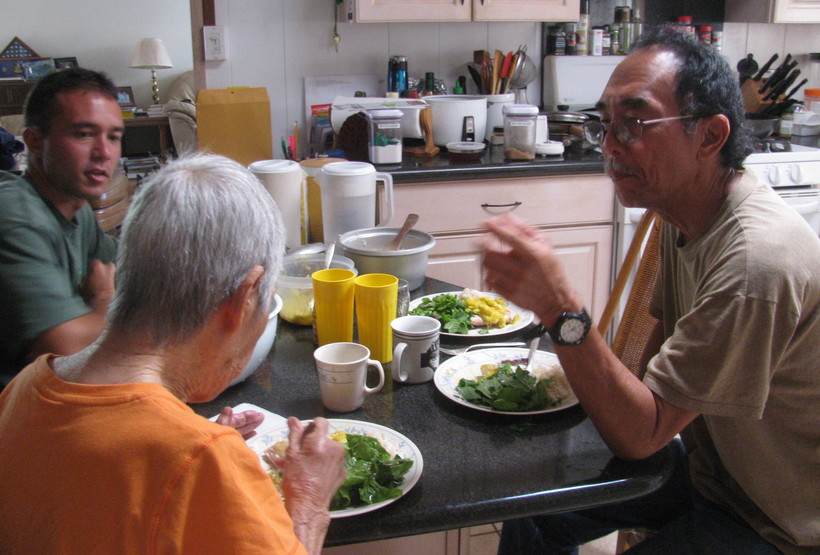
Thanks to her supportive family, Florence Yasuda is able to enjoy healthy meals in the company of loved ones.
We chose a nursing home about four miles from our Aiea home. On Day Five of her stay, she had an incident at breakfast (stiff, clenched hands; garbled speech). She was taken to a nearby emergency room. For the next two days, Florence slept without waking to eat, drink or use the bathroom. When she awoke, she ate with appetite and fed herself. Her speech was no longer garbled and there was no more stiffness in her limbs. But an oxygen tank arrived with her from the hospital and became a part of her standard equipment for the next several months. Florence continued to improve over the next six months. Ron visited the nursing home twice daily, and stayed for dinner. He did exercises nightly with Florence in her room to strengthen her legs.
Florence “graduated” from the nursing home in early August 2016, eight months after arriving. Our options for Florence’s living situations were:
- Remain at the nursing home: $9,000/mo
- Live at a foster/respite home: ~ $5000/mo
- Live at home: “Free” (provide care ourselves, hire caregivers, find a day care
Yasuda enjoys watching the chickens—and family members—come and go as she has her lunch.
Florence received PT and is now walking with a walker, and can descend/climb 16 stairs (with assistance) at our Aiea home. We also learned of a new nearby day care. Ron chose to retire a year early. This is our new schedule:
- Mon: Adult Day Care (9-3); Handi-Van pickup/drop off; Ron/Jan at night
- Tues: Caregiver (9-3); Ron/Jan at night; Troy (younger grandson) visits early in the week
- Wed: Jan and Ron (all day/all night)
- Thurs: Caregiver (9-3); Ron/Jan at night
- Fri: Adult Day Care (9-3); Handi-Van pickup/drop off; Ron/Jan at night
- Sat: Jan and Ron (all day/all night); occasional caregiver
- Sun: Jan and Ron (all day/all night); Jon (older grandson) comes to visit
Florence, 98, is able to participate in our daily lives, has a healthy appetite, loves watching the chickens (and us) crisscross our yard while she sits on the back lanai. She often says ”Thank you” and tells us how lucky she is. She still weighs 95 lbs.
It’s Christmas! (l-r) Ron Yasuda, Jan Pappas, Jon Yasuda, Troy Yasuda, Florence Yasuda
And how are we, the caregivers, doing? We feel fortunate to have enough funds to hire outside help. We alternate who gets up at night. We do our best to keep Florence comfortable and take her on outings.
Many others are not so lucky: They don’t get enough sleep. They never get a respite from providing non-stop care. Their loved one may require skilled nursing care which they can’t afford. They may have to care for their children as well as their parents. They will never have enough money due to many factors, including the high cost of medications, caregivers and premature retirement.
We cannot abandon our seniors. If businesses, lawmakers and the community come together, we can provide options to caregivers that can ease the burden that so many of us are feeling or will feel in our lifetimes.
Visit http://www.care4kupuna.com/ to learn more and add your voice to the call for better caregiving options.
Originally published by HuffPost Hawaiʻi. Read it there.
]]>Caring For A Loved One At Home: A Five Year Diary